eremeyuk@gmail.com
Vocal 3
Internal support
A continuous and steady reduction in support, resistance to movement
To sustain a note, the support must be a continuous and dynamic movement, and this should be done steadily, ‘as if working against resistance’. Internal support is the best way to conserve energy. To illustrate this resistance, raise your arm away from your body without any resistance and feel the muscles in your arm working. This isn’t particularly difficult. Now do the same thing, but this time apply pressure to the movement of your arm with your other hand. You will feel the muscles working harder. Now raise your arm in exactly the same way, but without applying pressure; this time, create resistance within the arm itself so that the movement looks and feels as though it is overcoming resistance. This makes the movement smooth and steady, whilst the energy expenditure is relatively high. Feel how the muscles are working.
It is precisely this ‘as if working against resistance’ that is so important. This resistance and steady muscle contraction must be incorporated into your support. You can experience this sensation when gently inflating balloons.
To sustain a note, the support must be a continuous and dynamic movement, and this should be done steadily, ‘as if working against resistance’. Internal support is the best way to conserve energy. To illustrate this resistance, raise your arm away from your body without any resistance and feel the muscles in your arm working. This isn’t particularly difficult. Now do the same thing, but this time apply pressure to the movement of your arm with your other hand. You will feel the muscles working harder. Now raise your arm in exactly the same way, but without applying pressure; this time, create resistance within the arm itself so that the movement looks and feels as though it is overcoming resistance. This makes the movement smooth and steady, whilst the energy expenditure is relatively high. Feel how the muscles are working.
It is precisely this ‘as if working against resistance’ that is so important. This resistance and steady muscle contraction must be incorporated into your support. You can experience this sensation when gently inflating balloons.
Finding inner support
Place your hands on your waist, cough, and as you do so, feel how the muscles in your waist push your hands outwards. Now press your hands inwards as hard as you can, but without causing any discomfort. Gently contract the muscles you felt when you coughed, and make them work as if they were pushing against resistance. Feel that slight contraction in your lower back; this is your ‘internal support’. Strengthen this support by contracting the muscles a little more. Eventually, the muscles will push outwards, counteracting your hands. When this happens, you have exceeded your internal support.
Start again and feel the contraction of the muscles once more, but make sure it does NOT push your hands outwards. It may feel as though the muscles are simply touching your hands, but not pushing them outwards. The moment you feel your hands being pushed outwards, the support will almost disappear, and you will no longer be able to contract your muscles, meaning your support will run out. This internal support is very economical, and with its help you will be able to achieve great power in your singing. Furthermore, you will have a reserve of movement (when your hands are pushed outwards) in case you need it. Be careful not to tense your abdomen, so as not to create incorrect support or hidden incorrect support.
Start again and feel the contraction of the muscles once more, but make sure it does NOT push your hands outwards. It may feel as though the muscles are simply touching your hands, but not pushing them outwards. The moment you feel your hands being pushed outwards, the support will almost disappear, and you will no longer be able to contract your muscles, meaning your support will run out. This internal support is very economical, and with its help you will be able to achieve great power in your singing. Furthermore, you will have a reserve of movement (when your hands are pushed outwards) in case you need it. Be careful not to tense your abdomen, so as not to create incorrect support or hidden incorrect support.
A sense of support – Natural and active support
To find the correct support for specific notes, a singer must take their natural support into account. During inhalation, the diaphragm contracts and descends, and naturally remains in this position for a short period whilst the initial volume of air is being used. This is called the ‘natural support’. At this moment, the singer does not need to apply physical force to support the voice, because the diaphragm is already naturally contracted. But as soon as the initial volume of air is exhaled, the diaphragm tends to relax and release the remaining air. It is at this very moment that the singer must gradually apply ‘active support’ to hold the air for as long as possible. Eventually, when almost all the air has been exhaled, active support will be at its maximum. At this point, the support can no longer control the exhalation, and the air escapes unevenly. This often happens in small bursts, and the tone becomes uneven and weak. Therefore, use active support ONLY when necessary. Maintain your support at the beginning of a note or phrase. Do not use active support until your natural support begins to weaken. You will have to work harder and harder gradually, and eventually you will be using only active support.
‘Zero point’ of support
It is very useful to be able to conserve your breath support. You can practise this as follows. Start by exhaling a very small amount of air, making the ‘sss’ sound or a note lower than the diaphragm would naturally produce. At first, this feels like holding your breath, as if you are retaining the air. This is a positive thing. It does not require much physical effort, but it feels as though the diaphragm is being held in tension. At a certain point, whilst maintaining support and pronouncing the sound ‘sss’ or a note, the pressure of the diaphragm increases, and the sensation changes. This is the zero point of support. As you continue to produce the ‘sss’ sound or note, the pressure on the diaphragm increases significantly, and from this point on it becomes harder to resist its movement. This is the downside. The singer usually feels that the air needs to be pushed out. This sensation often persists until the next inhalation.
So, the longer the exhalation, the more complex and difficult it is to hold the air. How long you can resist the pressure of the diaphragm depends on your technique, your physical strength and your stamina. Generally speaking, the longer you can prolong the sensation of holding your breath—in other words, the longer you maintain the positive effect—the better. When the sensation changes and you feel yourself struggling to exhale, you are approaching the point where you will want to take a new breath.
It is very useful to be able to conserve your breath support. You can practise this as follows. Start by exhaling a very small amount of air, making the ‘sss’ sound or a note lower than the diaphragm would naturally produce. At first, this feels like holding your breath, as if you are retaining the air. This is a positive thing. It does not require much physical effort, but it feels as though the diaphragm is being held in tension. At a certain point, whilst maintaining support and pronouncing the sound ‘sss’ or a note, the pressure of the diaphragm increases, and the sensation changes. This is the zero point of support. As you continue to produce the ‘sss’ sound or note, the pressure on the diaphragm increases significantly, and from this point on it becomes harder to resist its movement. This is the downside. The singer usually feels that the air needs to be pushed out. This sensation often persists until the next inhalation.
So, the longer the exhalation, the more complex and difficult it is to hold the air. How long you can resist the pressure of the diaphragm depends on your technique, your physical strength and your stamina. Generally speaking, the longer you can prolong the sensation of holding your breath—in other words, the longer you maintain the positive effect—the better. When the sensation changes and you feel yourself struggling to exhale, you are approaching the point where you will want to take a new breath.
A sense of support
- A feeling of support in the solar plexus areaPlace one hand on your solar plexus and the other on your abdomen around your navel. As you breathe out, the areas beneath your hands usually flatten out. As you breathe in, the areas beneath both hands usually expand. When you use the support, the upper bulge in the solar plexus area should PROTRUDE, whilst the lower bulge in the abdominal area around the navel should RETRACT.Continue
At first, it may be difficult to make these two areas work in opposition to each other, but practise slowly. If this seems difficult, start by allowing the protrusion in the solar plexus area to expand as much as possible, and let the abdomen around the navel follow suit and also protrude. When the protrusion in the solar plexus area is as large as possible, hold it in this position. If necessary, increase the pressure from within to keep it protruding. Now gently draw in the abdomen around the navel, without allowing the protrusion in the solar plexus area to disappear. The pulling in of the abdomen should not be particularly strong; simply feel it pull in slightly, without allowing the solar plexus to flatten. Maintain this sensation. As you get the hang of it, you will notice the interaction between the solar plexus and the abdomen. The more the abdomen is drawn in around the navel (up to a certain point), the more the solar plexus area protrudes. Familiarise yourself with this interaction and remember to maintain the sensation of working against resistance, as this continuous, steady movement actually serves as a foundation. You can now slowly practise this foundation by moving both hands back and forth, working against each other, using only your muscles and without breathing in or out.
- A feeling of support around the abdomenFeel your stomach being drawn inwards in one continuous movement, as if it were working against resistance. Be careful not to lock it in any point.Continue
- A feeling of support around the waistPlace your hands on your waist, cough, and feel your abdominal muscles pushing your hands outwards. Contract these muscles without coughing, feel the solar plexus tighten as well, and then gently draw your stomach in around your navel. Once this sensation becomes familiar, notice that as the stomach around your navel is drawn in, the waist and solar plexus muscles protrude.Continue
- A feeling of support in the backPlace your hands on your lower back, near your lower ribs, cough, and feel how the muscles in your lower back push your hands outwards. Contract these muscles without coughing. Gently pull your stomach in around your navel. Once you’re used to this sensation, notice that as your stomach pulls in around your navel, the muscles at the bottom of your back ribs push outwards.Continue
- A feeling of support in the ribsPlace your hands on your lower ribs, cough, and feel your lower ribs pushing your hands outwards. Expand your lower ribs without coughing. Keep your ribs expanded for as long as possible whilst singing. This will help you feel whether your support is maintained or not.Continue
- These five sensations of support (in the solar plexus, abdomen, waist, ribs and back) differ, but they all boil down to the same physical process and are simply different ways of FEELING that support. Please note that regardless of which sensation of support you use, you need to apply energy. Choose the sensation that feels most effective to you, or switch between them.
Get to know the sensation of support and try to link it to an image in your mind that you will always be able to recognise. Your own personal images and sensations will always be the best and most effective way to restore that feeling of support.
You may draw inspiration from the images and sensations used by other singers or singing teachers, but remember that these images, like your own, are based on subjective sensations and have no relation to the anatomy of the body. Therefore, treat these images ONLY as educational tools.
The following images and sensations help some singers but confuse others. Use them if you like them, but if you don’t respond to them straight away, forget about them. Again, do not confuse these images and sensations with what is actually happening. Such images and sensations of support include:
- being ready for a 20-metre sprint
- blowing up a balloon
- two muscles working against each other and meeting in the middle, pushing
something heavy away from
yourself
- a slow, continuous lowering of the shoulders
- restraint, a feeling of resistance, aversion
- the slow, continuous separation of two pieces of very strong tape
- ‘pulling up’ the womb
- ‘pulling up’ through the rectum (mainly for men)
- a valve attached to the navel, which lowers with support
- singing from the lower body
- singing along a single line internally, without going beyond that line
You may draw inspiration from the images and sensations used by other singers or singing teachers, but remember that these images, like your own, are based on subjective sensations and have no relation to the anatomy of the body. Therefore, treat these images ONLY as educational tools.
The following images and sensations help some singers but confuse others. Use them if you like them, but if you don’t respond to them straight away, forget about them. Again, do not confuse these images and sensations with what is actually happening. Such images and sensations of support include:
- being ready for a 20-metre sprint
- blowing up a balloon
- two muscles working against each other and meeting in the middle, pushing
something heavy away from
yourself
- a slow, continuous lowering of the shoulders
- restraint, a feeling of resistance, aversion
- the slow, continuous separation of two pieces of very strong tape
- ‘pulling up’ the womb
- ‘pulling up’ through the rectum (mainly for men)
- a valve attached to the navel, which lowers with support
- singing from the lower body
- singing along a single line internally, without going beyond that line
Incorrect support
You must be careful not to use the support incorrectly. This is known as the ‘toilet support’, which means that whilst the bulge in the solar plexus area is being stretched, the abdomen is ALSO pushed outwards, as if you were going to the toilet. If this happens, it puts severe pressure on the intestines, which can cause an uncontrollable tightening in the throat (try mimicking the act of going to the toilet and feel the uncontrollable tightening as you push your stomach out). If this happens whilst singing, it can interfere with your voice. In general, you should avoid putting pressure on your lower abdomen at any time. In women, prolonged increased pressure in the abdominal cavity can lead to uterine prolapse. Many musicians who play wind instruments have developed hernias, with pressure pushing outwards from the abdomen, whilst trying to use support. In general, there should be no pressure in the abdominal cavity.
NB: Pregnant singers or singers with abdominal issues should avoid this exercise.
Place one hand on your solar plexus and the other on your abdomen around your navel. Exhale and feel these areas relax beneath both hands as you breathe out. Breathe in and feel both your solar plexus and your abdomen expand. This is natural during inhalation, but should be avoided during exhalation, singing and support. With incorrect support, outward pressure is maintained on both the solar plexus and the abdomen around the navel. Feel the pressure on the lower abdomen and notice how it causes an uncontrolled contraction. You must correct this incorrect support by drawing in the abdomen around the navel continuously and steadily, whilst the bulge in the solar plexus area remains.
Place one hand on your solar plexus and the other on your abdomen around your navel. Exhale and feel these areas relax beneath both hands as you breathe out. Breathe in and feel both your solar plexus and your abdomen expand. This is natural during inhalation, but should be avoided during exhalation, singing and support. With incorrect support, outward pressure is maintained on both the solar plexus and the abdomen around the navel. Feel the pressure on the lower abdomen and notice how it causes an uncontrolled contraction. You must correct this incorrect support by drawing in the abdomen around the navel continuously and steadily, whilst the bulge in the solar plexus area remains.
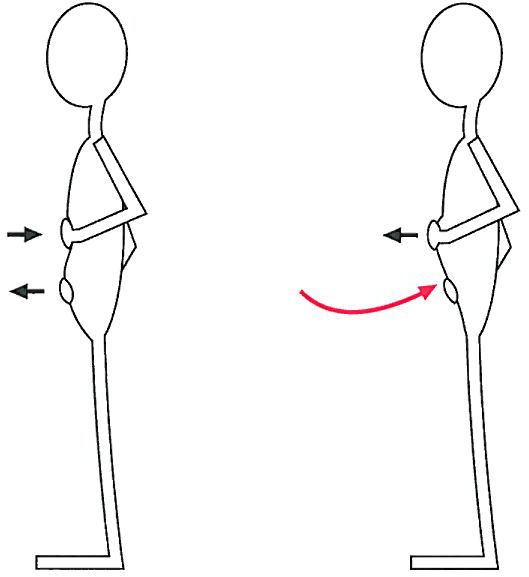
Place your hands on either side of your waist. Feel how, when you cough, the muscles in your waist push your hands outwards. If your posture is incorrect, BOTH the muscles in your waist AND the abdominal muscles around your navel will push outwards. Feel the pressure on your lower abdomen and notice how this causes an uncontrollable tightening. You must correct your posture by gently drawing your abdomen in around your navel, whilst keeping the muscles in your waist area engaged.
Even if you think you are supporting your voice correctly by pulling your stomach in around your navel, you still risk creating incorrect support. Another form of incorrect support involves pulling the stomach in too strongly and tensing it excessively. This is known as ‘hidden incorrect support’ and is more difficult to detect than standard incorrect support. It is usually detected when a singer contracts the support muscles strongly without achieving any positive results in the voice. With hidden incorrect support, one can usually hear that it causes uncontrolled constriction, and the singer often feels intense pressure in the solar plexus and abdomen. Nowadays, many singers believe that creating support really does require that much force. Despite tensing their abdominal muscles, the sound produced does not match their expectations. In an attempt to strengthen the support even further, the singer continues to increase the pressure. Eventually, they come to the conclusion that the problem may be linked to overdoing the support.
Neither of these two conclusions is correct. There is no support. In fact, what the singer perceives as support has turned into muscular tension, and no matter how much it is intensified, it will not improve the support or the sound. The body has lost control of the diaphragm, which has released most of the air, and the work of the abdominal muscles is futile. Hidden incorrect support feels like a sensation of stiffness in the abdominal area around the navel, just as with incorrect support. The only difference between a concealed poor posture and poor posture is that, with a concealed poor posture, the abdomen around the navel is drawn in.
Neither of these two conclusions is correct. There is no support. In fact, what the singer perceives as support has turned into muscular tension, and no matter how much it is intensified, it will not improve the support or the sound. The body has lost control of the diaphragm, which has released most of the air, and the work of the abdominal muscles is futile. Hidden incorrect support feels like a sensation of stiffness in the abdominal area around the navel, just as with incorrect support. The only difference between a concealed poor posture and poor posture is that, with a concealed poor posture, the abdomen around the navel is drawn in.
Place one hand on your solar plexus and the other on your abdomen around your navel. Exhale and feel both hands move inwards as the air leaves your lungs. Then inhale and feel your solar plexus and the area around your navel expand.
• With incorrect support, the solar plexus and the abdomen around the navel protrude outwards.
• With hidden incorrect support, the solar plexus remains protruding, whilst the abdomen around the navel is drawn inwards. Although the abdomen around the navel is drawn inwards, it remains firm and tense, as if it is still being pushed outwards. To demonstrate this, make the abdomen around the navel firm without pushing it outwards. It can be difficult to identify this as incorrect support, as the abdomen is drawn inwards.
• With correct support, the solar plexus remains extended, whilst the abdomen around the navel gently draws inwards. It is a drawing inwards, not a pushing outwards.
• With incorrect support, the solar plexus and the abdomen around the navel protrude outwards.
• With hidden incorrect support, the solar plexus remains protruding, whilst the abdomen around the navel is drawn inwards. Although the abdomen around the navel is drawn inwards, it remains firm and tense, as if it is still being pushed outwards. To demonstrate this, make the abdomen around the navel firm without pushing it outwards. It can be difficult to identify this as incorrect support, as the abdomen is drawn inwards.
• With correct support, the solar plexus remains extended, whilst the abdomen around the navel gently draws inwards. It is a drawing inwards, not a pushing outwards.
It is important to know how to release tension and replace an unconscious incorrect support with correct support at any moment. Tighten your abdomen around your navel. Then release the outward pressure and notice how you can gently draw your abdomen in even further. You must get used to this sensation of releasing the incorrect support. Virtually all singers have to do this at one point or another when working on their support. If you do not conserve your energy wisely, you easily risk leaving your abdominal muscles tense and clenched, i.e. with incorrect support or hidden incorrect support.
Conclusions
Support requires energy and strength
- Postpone using active support in your singing for as long as possible, as natural ‘free’ support occurs after inhaling.• The longer the support feels like a pause in breathing (i.e. ‘plus’) rather than a forced exhalation (i.e. ‘minus’), the better the result.1
- You can feel the support by keeping your ribs extended for as long as possible whilst singing• You can feel your core muscles working as you sense your solar plexus moving outwards, whilst the area around your navel moves inwards.2
- You can feel your supporting muscles working as you sense the muscles at the base of your ribs at the back moving outwards, whilst the area around your navel moves inwards• You can feel your core muscles working as your stomach pulls inwards in one continuous movement, as if working against resistanceия.3
- Internal support is the best way to save on support costs• Avoid poor support, which occurs when the abdomen around the navel bulges outwards.4
- Avoid hidden incorrect support, which occurs when the abdomen around the navel becomes firm, even though it is drawn inwards5
- Support requires energy and strength6
People won’t tire of dancing
and singing along with you!

E8 PRODUCTION
eremeyuk@gmail.com
+44 7729 759 359
Bring your most brilliant ideas to life!
:
All photographs, text and video material belong to their respective owners and are used for illustrative purposes only. Please do not use this content for commercial purposes.
All photographs, text and video material belong to their respective owners and are used for illustrative purposes only. Please do not use this content for commercial purposes.
