
eremeyuk@gmail.com
The mathematical foundations of music were studied in all ancient Eastern civilisations.
Universal harmony
The relationship between pitch and the construction of musical instruments was recognised quite early on. The fundamental structural units of music—the notes of the scale—were identified, and their mathematical relationships, as well as their melodic and harmonic significance, were established. All of this was of immense importance to the development of musical art as a whole.
The relationship between pitch and the construction of musical instruments was recognised quite early on. The fundamental structural units of music—the notes of the scale—were identified, and their mathematical relationships, as well as their melodic and harmonic significance, were established. All of this was of immense importance to the development of musical art as a whole.
All this was of immense significance for the development of musical art as a whole. However, it is important to emphasise that the ancient science of music was somewhat broader in scope than was required for musical practice. The ancient theorists’ commitment to precise numerical measurements of the musical scale was only partly driven by a desire to provide the most accurate description of the musical-acoustic laws necessary for sound production. According to the natural philosophical teachings of the time, it was believed that musical-mathematical relationships expressed the general laws underlying the universe. Ancient Eastern music theorists were primarily focused on identifying these laws.
Ancient people typically viewed music as something primordial. In India, for example, there was a doctrine concerning the supreme sound ‘Nada-Brahman’, which is the seed of the entire universe. In its primary, ‘unmanifested’ (anahata) state, it is latent; it then unfolds into the visible world, which consists of vibrations of varying pitches. The audible range is only a part of these vibrations, yet it too reflects all the fundamental laws of the universe.
According to ancient Chinese beliefs, music was also present at the dawn of the universe:
“The origins of music are ancient. It was created according to specific rhythms, and its foundation lies in the Great Beginning. The Great Beginning gave rise to heaven and earth, and these in turn gave rise to yin and yang. Yin and yang, [constantly] changing, sometimes rising upwards, sometimes sinking downwards, combine with one another to form phenomena”;
“Music is that which expresses the harmony of heaven and earth, the harmony of yin and yang” (“Lüshi Chunqiu”)
The structure of the traditional Chinese musical scale corresponds exactly to the ancient Chinese conception of the structure of the cosmos. The five tones of the Chinese scale were symbolised, as shown in Table 5.1.1, by the five elements and were thus associated with all their corresponding phenomena. The French sinologist M. Granet, analysing the numerical symbolism of the elements and the proportions of the five tones, put forward the hypothesis that the ancient Chinese musical scale was primary in relation to the five elements.
An important place in the musical theory of ancient China was occupied by the doctrine of the 12-lüy system – a scale of 12 steps within an octave, upon which all traditional tonal modes are based. Without an understanding of the structure of this system, it is impossible to fully comprehend ancient Chinese musical theory. The 12-lüy system is more than just a collection of musical tones. It held cultural significance as a theoretical foundation for social regulation within the country and for achieving human psychological harmony. Its mathematical principles formed the basis of the system of weights and measures and were taken into account when compiling calendars.
According to legend, the 12 lü were created during the reign of the semi-mythical Emperor Huangdi, who ordered his Minister of Music, Ling Lun, to craft bamboo flutes (lü). As he set to work, two divine birds—a male and a female phoenix—suddenly appeared before him. Each sang six notes – six ‘yin’ and six ‘yang’ notes, which were in specific relationships to one another. Having thus grasped the structure of the musical scale, Lin Lun crafted 12 bamboo flutes, which formed the basis of the musical system. Huang Di then ordered 12 bells to be cast with the same tones. The first was named ‘huang zhong’ (‘yellow bell’), as the colour yellow was a symbol of imperial power.
In reality, the 12-lüy system only took shape during the Zhou dynasty, although the traditional pentatonic scale, based on the principles laid down in this system, already existed by the end of the 2nd millennium BCE. The earliest surviving text to record the mathematical method of constructing the 12 lü is the “Lü Shi Chun Qiu” (3rd century BC). This text served as the basis for further mathematical studies of music, and it must be said that the ancient Chinese were highly successful in this regard. In their mathematical assessments of musical proportions, the Chinese were on a par with the Greeks. In the 16th century, the music theorist Zai Yu constructed a tempered scale based on the lü system, predating A. Werkmeister by a century.
There are many legends surrounding the remarkable qualities of the 12 lü. It is worth noting that in all ancient civilisations, music was regarded as something capable of exerting a transformative influence on nature. This was also the case in China: legendary musicians calmed the winds and tamed the heat of the sun with their playing; under the influence of their music, seeds sprouted in a short time and living organisms developed at a fantastic rate.
It was believed that music could serve as a tuning fork for natural phenomena. There is a well-known account of an intriguing experiment to verify the accuracy of calendar changes (ci hou). It involved a mysterious device made up of 12 lu flutes. Each was placed at a slight angle on a separate table. The flutes were filled with ash obtained by burning the inner membrane of a special type of reed, and their ends were covered with a thin silk cloth. The tables with the flutes were arranged in specific directions in a circle. To eliminate the influence of wind and noise, the experiment had to be conducted in an airtight room with triple walls. It was assumed that the ash would emerge from the flutes at the moment when the calendar period corresponding to the pitch of a particular flute began. History records at least three successful instances when the experiment was successful.
It is difficult to imagine what might have caused ash to emerge from the flutes at that particular time of year. This phenomenon defies modern scientific explanation, and it cannot be ruled out that the description is missing some detail that would clarify the matter. Perhaps what was meant was not a synchronous, monthly ‘triggering’ of the flutes, but a spontaneous one; and thus, this device could have been used for divination purposes. After all, the encoding of the tones of the 12-lüy system using the hexagrams of the ‘Canon of Changes’ (see Fig. 4.4.3-4) did not exist for no reason. But let us leave the speculation aside and move on to examining some aspects of the structure of the 12-lüy system itself.
All 12 lü fit within an octave range. An octave in music is the equivalent of the number 10 in arithmetic. Just as 10 sets a certain rhythm of structural repetitions in the natural number sequence, so the octave is an invariant system of relationships between the degrees of the scale. The 8th degree is an octave repetition of the 1st, the 9th of the 2nd, and so on.
From an acoustic point of view, an octave represents a doubling of the frequency of sound waves. In other words, if the first sound is, for example, 440 Hz, then its octave is a sound with a frequency of 880 Hz. However, in music, it is the ratios of frequencies that are important, rather than their absolute values; therefore, an octave is conventionally expressed as a ratio of 1 to 2. If we speak not of frequency (v) but of the period of oscillation (T = 1/v), then the octave ratio will be defined by the numbers 1 and 1/2. All other steps of the octave are expressed as fractions lying between 1 and 2 or 1 and 1/2.
It has been observed that the most harmonious intervals are those that can be expressed by only a few rational numbers, i.e. those composed of whole numbers. One such interval is the fifth (i.e. the fifth degree). Its numerical value is 2/3. It is this ratio that forms the basis for constructing the 12-lüy system. Thus, two degrees of this system are already known: the tonic (1) and the fifth (2/3). Now we must construct a fifth interval from the existing fifth. Mathematically, this is expressed as a product: 2/3 × 2/3 = 4/9. But this degree lies outside the octave. To ‘bring’ it back into the octave range, an octave transposition is performed: 4/9 × 2 = 8/9 (when constructing the 12-lüy system, the Chinese immediately took into account the need for octave transposition by introducing a 4/3 coefficient into the fifth progression in certain places) . The fraction 8/9 will correspond to the interval of the 2nd degree – a second. Next, a fifth interval must be constructed again from the resulting degree: 8/9 × 2/3 = 16/27. This is a sixth interval, i.e. the 6th degree. The next fifth progression will again take us beyond the octave, so we will have to transpose again, and so on.
The sequence of tones when constructing a scale was known as the ‘mutual generation’ order. The tones resulting within the octave range are arranged by pitch—this is the ‘pitch-based’ order. In both cases, the odd-numbered tones are ‘yang’, and the even-numbered tones are ‘yin’. When the order is changed, the even tones change their position, whilst the odd tones do not. This can be seen from the tables showing the “mutual generation” order (Table 5.4.1) and the “pitch” order (Table 5.4.2). These tables present numerical expressions (col. 3) of the degrees (col. 1), their Chinese names (col. 2) and approximate correspondence to the European scale (col. 4), as well as the Chinese pentatonic scale (col. 5).
Ancient people typically viewed music as something primordial. In India, for example, there was a doctrine concerning the supreme sound ‘Nada-Brahman’, which is the seed of the entire universe. In its primary, ‘unmanifested’ (anahata) state, it is latent; it then unfolds into the visible world, which consists of vibrations of varying pitches. The audible range is only a part of these vibrations, yet it too reflects all the fundamental laws of the universe.
According to ancient Chinese beliefs, music was also present at the dawn of the universe:
“The origins of music are ancient. It was created according to specific rhythms, and its foundation lies in the Great Beginning. The Great Beginning gave rise to heaven and earth, and these in turn gave rise to yin and yang. Yin and yang, [constantly] changing, sometimes rising upwards, sometimes sinking downwards, combine with one another to form phenomena”;
“Music is that which expresses the harmony of heaven and earth, the harmony of yin and yang” (“Lüshi Chunqiu”)
The structure of the traditional Chinese musical scale corresponds exactly to the ancient Chinese conception of the structure of the cosmos. The five tones of the Chinese scale were symbolised, as shown in Table 5.1.1, by the five elements and were thus associated with all their corresponding phenomena. The French sinologist M. Granet, analysing the numerical symbolism of the elements and the proportions of the five tones, put forward the hypothesis that the ancient Chinese musical scale was primary in relation to the five elements.
An important place in the musical theory of ancient China was occupied by the doctrine of the 12-lüy system – a scale of 12 steps within an octave, upon which all traditional tonal modes are based. Without an understanding of the structure of this system, it is impossible to fully comprehend ancient Chinese musical theory. The 12-lüy system is more than just a collection of musical tones. It held cultural significance as a theoretical foundation for social regulation within the country and for achieving human psychological harmony. Its mathematical principles formed the basis of the system of weights and measures and were taken into account when compiling calendars.
According to legend, the 12 lü were created during the reign of the semi-mythical Emperor Huangdi, who ordered his Minister of Music, Ling Lun, to craft bamboo flutes (lü). As he set to work, two divine birds—a male and a female phoenix—suddenly appeared before him. Each sang six notes – six ‘yin’ and six ‘yang’ notes, which were in specific relationships to one another. Having thus grasped the structure of the musical scale, Lin Lun crafted 12 bamboo flutes, which formed the basis of the musical system. Huang Di then ordered 12 bells to be cast with the same tones. The first was named ‘huang zhong’ (‘yellow bell’), as the colour yellow was a symbol of imperial power.
In reality, the 12-lüy system only took shape during the Zhou dynasty, although the traditional pentatonic scale, based on the principles laid down in this system, already existed by the end of the 2nd millennium BCE. The earliest surviving text to record the mathematical method of constructing the 12 lü is the “Lü Shi Chun Qiu” (3rd century BC). This text served as the basis for further mathematical studies of music, and it must be said that the ancient Chinese were highly successful in this regard. In their mathematical assessments of musical proportions, the Chinese were on a par with the Greeks. In the 16th century, the music theorist Zai Yu constructed a tempered scale based on the lü system, predating A. Werkmeister by a century.
There are many legends surrounding the remarkable qualities of the 12 lü. It is worth noting that in all ancient civilisations, music was regarded as something capable of exerting a transformative influence on nature. This was also the case in China: legendary musicians calmed the winds and tamed the heat of the sun with their playing; under the influence of their music, seeds sprouted in a short time and living organisms developed at a fantastic rate.
It was believed that music could serve as a tuning fork for natural phenomena. There is a well-known account of an intriguing experiment to verify the accuracy of calendar changes (ci hou). It involved a mysterious device made up of 12 lu flutes. Each was placed at a slight angle on a separate table. The flutes were filled with ash obtained by burning the inner membrane of a special type of reed, and their ends were covered with a thin silk cloth. The tables with the flutes were arranged in specific directions in a circle. To eliminate the influence of wind and noise, the experiment had to be conducted in an airtight room with triple walls. It was assumed that the ash would emerge from the flutes at the moment when the calendar period corresponding to the pitch of a particular flute began. History records at least three successful instances when the experiment was successful.
It is difficult to imagine what might have caused ash to emerge from the flutes at that particular time of year. This phenomenon defies modern scientific explanation, and it cannot be ruled out that the description is missing some detail that would clarify the matter. Perhaps what was meant was not a synchronous, monthly ‘triggering’ of the flutes, but a spontaneous one; and thus, this device could have been used for divination purposes. After all, the encoding of the tones of the 12-lüy system using the hexagrams of the ‘Canon of Changes’ (see Fig. 4.4.3-4) did not exist for no reason. But let us leave the speculation aside and move on to examining some aspects of the structure of the 12-lüy system itself.
All 12 lü fit within an octave range. An octave in music is the equivalent of the number 10 in arithmetic. Just as 10 sets a certain rhythm of structural repetitions in the natural number sequence, so the octave is an invariant system of relationships between the degrees of the scale. The 8th degree is an octave repetition of the 1st, the 9th of the 2nd, and so on.
From an acoustic point of view, an octave represents a doubling of the frequency of sound waves. In other words, if the first sound is, for example, 440 Hz, then its octave is a sound with a frequency of 880 Hz. However, in music, it is the ratios of frequencies that are important, rather than their absolute values; therefore, an octave is conventionally expressed as a ratio of 1 to 2. If we speak not of frequency (v) but of the period of oscillation (T = 1/v), then the octave ratio will be defined by the numbers 1 and 1/2. All other steps of the octave are expressed as fractions lying between 1 and 2 or 1 and 1/2.
It has been observed that the most harmonious intervals are those that can be expressed by only a few rational numbers, i.e. those composed of whole numbers. One such interval is the fifth (i.e. the fifth degree). Its numerical value is 2/3. It is this ratio that forms the basis for constructing the 12-lüy system. Thus, two degrees of this system are already known: the tonic (1) and the fifth (2/3). Now we must construct a fifth interval from the existing fifth. Mathematically, this is expressed as a product: 2/3 × 2/3 = 4/9. But this degree lies outside the octave. To ‘bring’ it back into the octave range, an octave transposition is performed: 4/9 × 2 = 8/9 (when constructing the 12-lüy system, the Chinese immediately took into account the need for octave transposition by introducing a 4/3 coefficient into the fifth progression in certain places) . The fraction 8/9 will correspond to the interval of the 2nd degree – a second. Next, a fifth interval must be constructed again from the resulting degree: 8/9 × 2/3 = 16/27. This is a sixth interval, i.e. the 6th degree. The next fifth progression will again take us beyond the octave, so we will have to transpose again, and so on.
The sequence of tones when constructing a scale was known as the ‘mutual generation’ order. The tones resulting within the octave range are arranged by pitch—this is the ‘pitch-based’ order. In both cases, the odd-numbered tones are ‘yang’, and the even-numbered tones are ‘yin’. When the order is changed, the even tones change their position, whilst the odd tones do not. This can be seen from the tables showing the “mutual generation” order (Table 5.4.1) and the “pitch” order (Table 5.4.2). These tables present numerical expressions (col. 3) of the degrees (col. 1), their Chinese names (col. 2) and approximate correspondence to the European scale (col. 4), as well as the Chinese pentatonic scale (col. 5).
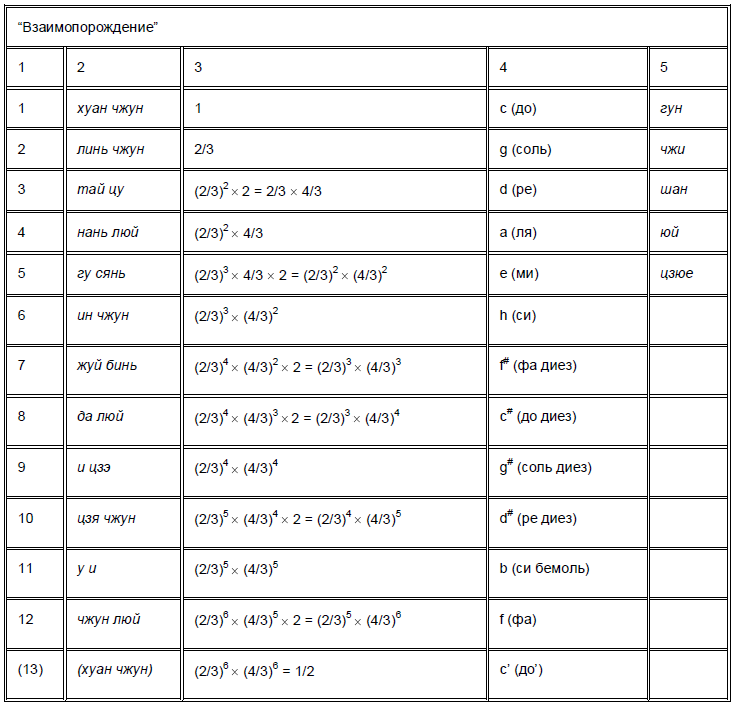
The 12-lüy scale is open-ended. If one were to continue the sequence of fifths from the final, 12th degree, the next degree would not coincide with the octave; it is only for the sake of simplicity that they may be considered to coincide approximately. The Chinese were well aware of this, which is why the 13th tone was constructed as an octave repetition of the first.
5.4.1
Both arrangements of the 12 lü correspond to the cyclical signs. Therefore, they can be plotted on a basis diagram, which will make the construction of the scale using the pentatonic scale more intuitive. Figure 5.4.1 shows the 12-lüy scale in the ‘mutual generation’ order, and Figure 5.4.2 shows it in the ‘pitch’ order. The transition from the ‘mutual generation’ order to the ‘pitch’ order, and vice versa, is achieved in the diagrams by means of a diametrical transposition of the ‘yin’ lü. The ‘yang’ lü, meanwhile, remain in their original positions. The fifth progression, which is depicted on a circle in Fig. 5.4.1, forms a “star” shape in Fig. 5.4.2. Fig. 5.4.1 shows that, if transposition coefficients are disregarded, the 12-tone fifth progression spans approximately 7 octaves, whereas in Fig. 5.4.2 these 7 octaves are, as it were, ‘collapsed’ into a single one. This is an important pattern that will prove useful in further research.
5.4.2
The traditional Chinese pentatonic scale is constructed very simply. One need only take the first five notes of the 12 lü in the order of ‘mutual generation’ and arrange them in ascending order of pitch. A heptatonic scale (a seven-note scale) can be constructed in the same way.
The pentatonic and heptatonic scales were widely used in the musical practice of ancient China. They were classified by mode and key. The note on which the scale is based determines its key. In total, there were 12 tonalities – corresponding to the number of lü. If each of the degrees of the pentatonic scale is taken as the tonic, this results in 5 modes. Altogether, this amounts to 5 × 12 = 60 mode-tonalities, upon which all traditional music was based.
Each degree of the pentatonic scale, as shown in Tables 5.4.1 and 5.4.2, has its own name. When constructing the heptatonic scale, two names already present in the pentatonic scale are used with the addition of the character ‘bian’ (‘modified’) – bian gong and bian zhi.
The pentatonic and heptatonic scales were widely used in the musical practice of ancient China. They were classified by mode and key. The note on which the scale is based determines its key. In total, there were 12 tonalities – corresponding to the number of lü. If each of the degrees of the pentatonic scale is taken as the tonic, this results in 5 modes. Altogether, this amounts to 5 × 12 = 60 mode-tonalities, upon which all traditional music was based.
Each degree of the pentatonic scale, as shown in Tables 5.4.1 and 5.4.2, has its own name. When constructing the heptatonic scale, two names already present in the pentatonic scale are used with the addition of the character ‘bian’ (‘modified’) – bian gong and bian zhi.
5.4.3
The Chinese symbolised the degrees of the pentatonic scale with the five elements in a rather peculiar combination: they aligned the elements in ‘cosmogonic’ order with the pentatonic scale ‘by pitch’ (Fig. 5.4.3, in brackets), which contradicts the logic underlying the structure of the entire traditional musical system. This is clearly visible in the figure: the cyclical signs and the 12 lü correlate with the elements in the order of ‘mutual generation’, with which only two elements from the pentatonic symbolism coincide – earth and metal.
In musical-melodic terms, the tonic gong was regarded as the middle:
“Sound is born of harmony, and harmony arises from correspondence [with the middle of opposing principles]. Harmony and correspondence [with the middle] are the basis upon which the wise rulers of the past created music” (“Lüshi Chunqiu”)
Thus, the connection between the tonic gong and the element earth – the middle among the elements – seems appropriate here. The basic position of the tonic gong as the first step of the lü – huang zhong (“yellow bell”) – is entirely justified, for the colour yellow is a symbol of earth.
Furthermore, there were two versions of the distribution of the 12 lü across the months of the year, in which huangzhong corresponded to either the winter or summer solstice. The latter seems more logical, since midsummer was symbolised by the same element – earth. M. V. Isaeva reports that, viewing the system of the 12 lü as a cosmological model describing the process of the generation of all things from the Great Limit, Chinese scholars considered the tone of huangzhong to be a musical analogue of the latter. In Ancient China, the summer solstice was associated with the Great Limit, whilst the winter solstice was associated with ‘primordial chaos’. Thus, here too, the connection between the Huangzhong tone and the summer solstice (and therefore with the element of earth) is far more appropriate than with the winter solstice. Moreover, with this arrangement of the tone, a certain semantic correspondence emerges between the names of several steps (namely those on which a pentatonic scale can be constructed) and the elements arranged on the basis diagram in the order of ‘mutual generation’ (Fig. 5.4.4), namely: the ‘old bathhouse’ (gu xian) corresponds to water; the ‘forest bell’ (lin zhong) to wood; the ‘southern flute’ (nan lü) to fire (its position is the south). Based on the above, it can be assumed that this was precisely the original correlation between the 12 lü and the pentatonic scale with the elements.
In musical-melodic terms, the tonic gong was regarded as the middle:
“Sound is born of harmony, and harmony arises from correspondence [with the middle of opposing principles]. Harmony and correspondence [with the middle] are the basis upon which the wise rulers of the past created music” (“Lüshi Chunqiu”)
Thus, the connection between the tonic gong and the element earth – the middle among the elements – seems appropriate here. The basic position of the tonic gong as the first step of the lü – huang zhong (“yellow bell”) – is entirely justified, for the colour yellow is a symbol of earth.
Furthermore, there were two versions of the distribution of the 12 lü across the months of the year, in which huangzhong corresponded to either the winter or summer solstice. The latter seems more logical, since midsummer was symbolised by the same element – earth. M. V. Isaeva reports that, viewing the system of the 12 lü as a cosmological model describing the process of the generation of all things from the Great Limit, Chinese scholars considered the tone of huangzhong to be a musical analogue of the latter. In Ancient China, the summer solstice was associated with the Great Limit, whilst the winter solstice was associated with ‘primordial chaos’. Thus, here too, the connection between the Huangzhong tone and the summer solstice (and therefore with the element of earth) is far more appropriate than with the winter solstice. Moreover, with this arrangement of the tone, a certain semantic correspondence emerges between the names of several steps (namely those on which a pentatonic scale can be constructed) and the elements arranged on the basis diagram in the order of ‘mutual generation’ (Fig. 5.4.4), namely: the ‘old bathhouse’ (gu xian) corresponds to water; the ‘forest bell’ (lin zhong) to wood; the ‘southern flute’ (nan lü) to fire (its position is the south). Based on the above, it can be assumed that this was precisely the original correlation between the 12 lü and the pentatonic scale with the elements.
If one accepts this correlation, then the traditional Chinese pentatonic scale should be regarded as the musical-mathematical foundation of the theory of the five elements. Indeed, the sequence of fifths upon which the pentatonic scale is based is analogous to the order of the ‘mutual overcoming’ of the elements, presented in reverse. Together with the order of ‘mutual generation’, the latter forms the diagram of the pentagram in a circle (see Figs. 3.2.1, 5.3.10), similar to the diagram in Fig. 5.4.4.
5.4.4
It should be noted that the fifth-step progression in the 12-Lü system bears a name synonymous with one of the orders of the elements, namely the order of ‘mutual generation’, although it correlates with another—the opposite order of ‘mutual overcoming’. But this is, obviously, merely a terminological inconsistency, for, in essence, ‘reverse overcoming’ is nothing other than ‘generation’.
It is known from physics that oscillations with a higher frequency possess greater energy. In music, a higher frequency of oscillations corresponds to a higher-pitched sound, perceived as having greater intensity. From a thermodynamic perspective, an increase in the frequency of molecular oscillations leads to phase transitions of matter from the solid to the liquid, gaseous and plasma states. If we combine the ‘musical’ diagrams discussed with the diagram in Fig. 5.3.18, which presents a set of Indian elements, the order of their ‘generation’ will coincide with the rise in the pitch of the musical scale, and thus it can be interpreted as a change in the phase states of matter.
The Chinese elements cannot be interpreted in this way. They bear little resemblance to the phase states of matter; nevertheless, the order of ‘mutual generation’, as it correlates with an ascending scale, should be regarded as describing an increase in energy. However, there is something rather odd here – for if we consider the process of generation over time, then according to the law of entropy, energy should decrease, not increase. Does this not imply that this sequence incorporates some mechanism designed to combat entropy? But what kind? It could be a description of the workings of the human organism (or a similar system), for the correlation between the elements and the organs of the body is well known.
According to Chinese theory, the circulation of pneuma-qi in the organism occurs simultaneously with its transformation (bian). The various forms of pneuma that arise in this process correlate with the elements, and consequently with the traditional musical scale. Thus, it can be assumed that the transformations of pneuma occur in musical proportions as changes in its ‘quantisation’.
Here, as in physics, a quantum is understood to be a carrier of the properties of a physical field, characterised by frequency (v), period of oscillation (T = 1/v), wavelength (L = vT), energy (E = v²), and so on. For example, there are quanta of the electromagnetic field—photons—and of the sound field—phonons—and so on.
The ‘quantum’ approach allows us to resolve the internal contradiction in defining the category of pneuma-qi, which is continuous by nature but appears, in its manifested forms, as if it were discrete entities. In reality, however, these entities are merely quanta—fragments of the continuous world space.
The ancient Chinese believed that the “primordial pneuma” (yuan qi) in the act of the self-creation of the cosmos differentiates into yang qi and yin qi, i.e. light, subtle, “clear” (qing) and heavy, thick, “turbid” (zhe) particles (read: ‘quanta’) of the pneuma-qi. This results in a scale of qi modifications, similar to a musical scale (yang – high-pitched sounds with shorter wavelengths – ‘subtle’; yin – low-pitched sounds with longer wavelengths – ‘dense’). If we map the “10,000 things” (wan wu), consisting of pneuma of varying quality, onto this scale, then the entire cosmos can be viewed as a system of objects possessing vibrations of different frequencies and existing in harmonic relationships, similar to those in music.
It is known from physics that oscillations with a higher frequency possess greater energy. In music, a higher frequency of oscillations corresponds to a higher-pitched sound, perceived as having greater intensity. From a thermodynamic perspective, an increase in the frequency of molecular oscillations leads to phase transitions of matter from the solid to the liquid, gaseous and plasma states. If we combine the ‘musical’ diagrams discussed with the diagram in Fig. 5.3.18, which presents a set of Indian elements, the order of their ‘generation’ will coincide with the rise in the pitch of the musical scale, and thus it can be interpreted as a change in the phase states of matter.
The Chinese elements cannot be interpreted in this way. They bear little resemblance to the phase states of matter; nevertheless, the order of ‘mutual generation’, as it correlates with an ascending scale, should be regarded as describing an increase in energy. However, there is something rather odd here – for if we consider the process of generation over time, then according to the law of entropy, energy should decrease, not increase. Does this not imply that this sequence incorporates some mechanism designed to combat entropy? But what kind? It could be a description of the workings of the human organism (or a similar system), for the correlation between the elements and the organs of the body is well known.
According to Chinese theory, the circulation of pneuma-qi in the organism occurs simultaneously with its transformation (bian). The various forms of pneuma that arise in this process correlate with the elements, and consequently with the traditional musical scale. Thus, it can be assumed that the transformations of pneuma occur in musical proportions as changes in its ‘quantisation’.
Here, as in physics, a quantum is understood to be a carrier of the properties of a physical field, characterised by frequency (v), period of oscillation (T = 1/v), wavelength (L = vT), energy (E = v²), and so on. For example, there are quanta of the electromagnetic field—photons—and of the sound field—phonons—and so on.
The ‘quantum’ approach allows us to resolve the internal contradiction in defining the category of pneuma-qi, which is continuous by nature but appears, in its manifested forms, as if it were discrete entities. In reality, however, these entities are merely quanta—fragments of the continuous world space.
The ancient Chinese believed that the “primordial pneuma” (yuan qi) in the act of the self-creation of the cosmos differentiates into yang qi and yin qi, i.e. light, subtle, “clear” (qing) and heavy, thick, “turbid” (zhe) particles (read: ‘quanta’) of the pneuma-qi. This results in a scale of qi modifications, similar to a musical scale (yang – high-pitched sounds with shorter wavelengths – ‘subtle’; yin – low-pitched sounds with longer wavelengths – ‘dense’). If we map the “10,000 things” (wan wu), consisting of pneuma of varying quality, onto this scale, then the entire cosmos can be viewed as a system of objects possessing vibrations of different frequencies and existing in harmonic relationships, similar to those in music.
-
 Bibliography:
 -
 SourceA Map of the Anthropocosmos
Moscow 1993 -
 AuthorV.E. EREMEEV
Contacts
+44 7729 759 359
eremeyuk@gmail.com
eremeyuk@gmail.com
All photographs, text and video material belong to their respective owners and are used for demonstration purposes only. Please do not use the content of this template for commercial purposes.
